Multi-Axle & Modular Trailers
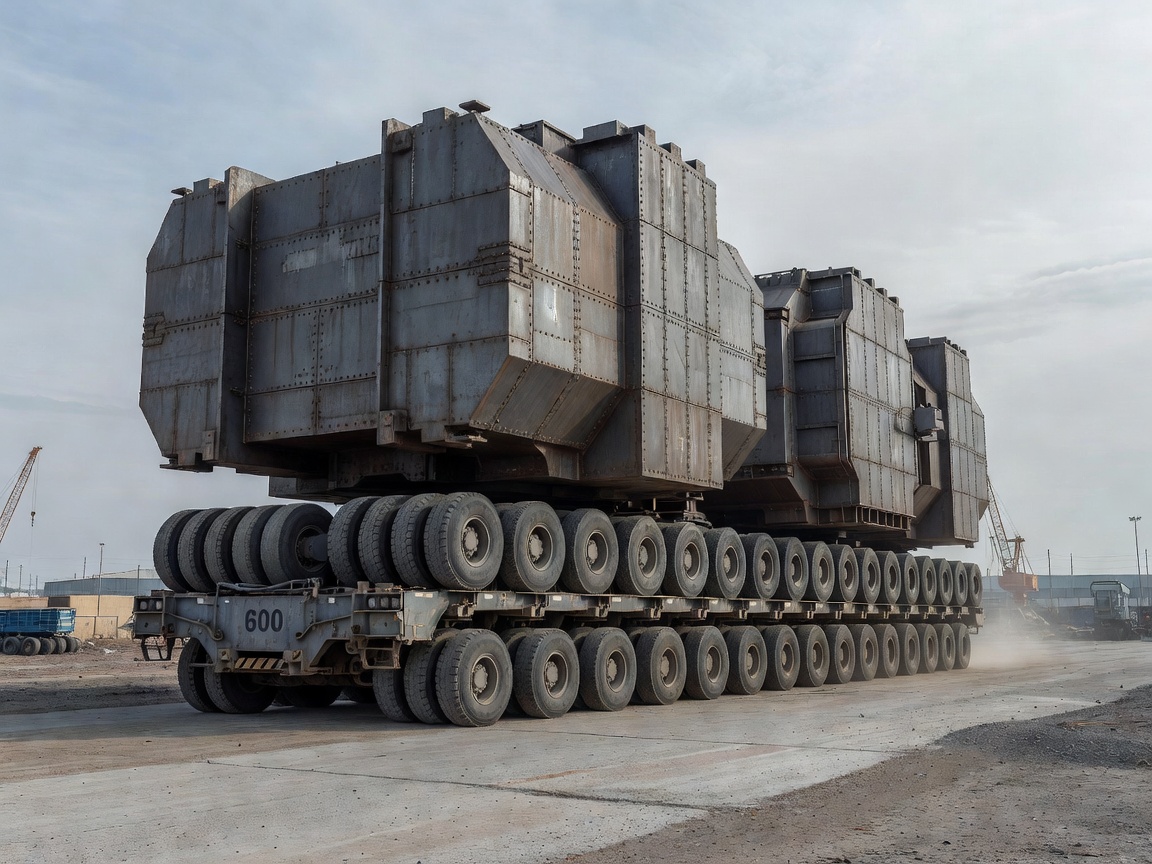
Engineered for the Heaviest Loads on Earth
When industrial payloads exceed the structural capacities of standard flatbeds, lowboys, or step-deck trailers, the transport industry turns to highly specialized modular equipment. Moving massive continuous structures—such as oil refinery vessels, bridge sections, or maritime engine blocks—requires platforms that can distribute immense weight over a massive footprint to protect the road surface and infrastructure. This is the domain of multi-axle modular trailers and Self-Propelled Modular Transporters (SPMTs).
At Poppiowonderfl Transport Ltd., we utilize the most advanced modular transport technology available. These highly adaptable platforms are not single, static trailers, but rather mechanical building blocks that can be configured in endless combinations to suit the exact dimensions, weight distribution, and center of gravity of the payload.
The Mechanics of Modular Trailers
Unlike standard trailers that rely on a fixed frame and conventional air-ride or leaf-spring suspension, modular trailers are built on a central spine with pivoting pendulum axles. These axles feature sophisticated hydraulic suspension systems. This design provides several critical advantages for heavy-haul logistics:
- Hydraulic Equalization: When traversing uneven ground, crowned roads, or slight inclines, the hydraulic suspension automatically adjusts the height of individual axles. This ensures that the weight of the load remains perfectly distributed across all tires at all times, preventing concentrated stress that could crack the pavement or destabilize the load.
- Independent Steering: Navigating corners with a 150-foot trailer is mechanically impossible with fixed axles. Modular trailers feature all-wheel electronic or mechanical steering. A remote operator or an automated steering system can turn all the axles simultaneously, allowing the massive trailer to "crab walk" sideways or pivot tightly around tight urban corners.
- Scalability: Modular trailers are designed to connect to one another, either longitudinally (end-to-end) to accommodate extremely long loads like wind turbine blades, or laterally (side-by-side) to support ultra-heavy, wide loads like industrial transformers.
Self-Propelled Modular Transporters (SPMTs)
For the absolute pinnacle of heavy hauling, SPMTs are utilized. An SPMT is a platform vehicle with a large array of wheels that operates without a traditional tractor truck pulling it. Instead, it is powered by an attached Power Pack Unit (PPU) that drives hydraulic motors located in the wheel hubs.
SPMTs can carry tens of thousands of tons. They are commonly used in shipyards, petrochemical plants, and large-scale civil engineering projects. A single operator walks alongside the unit, controlling the entire platform via a computerized remote-control belly pack. The computer system synchronizes the steering and driving of hundreds of individual wheels, allowing millimeter-precision placement of colossal structures.
Load Calculation and Center of Gravity
Deploying modular trailers is a highly technical engineering task. Before a load is placed on a trailer, transport engineers use specialized software to calculate the exact center of gravity (CoG). If the CoG is miscalculated, the load could tip the trailer during a turn, or put excessive pressure on one side of the platform, blowing out tires and destroying axles.
Engineers calculate exactly how many axle lines are required to meet legal ground-bearing pressure limits. They also determine the necessary hydraulic pressure settings for the suspension to ensure the platform remains perfectly level regardless of the terrain underneath.
Comparison: Conventional vs. Modular
| Feature | Conventional Lowboy | Modular Trailer (SPMT / Multi-Axle) |
|---|---|---|
| Weight Capacity | Up to ~100,000 lbs | Theoretically unlimited (scales with axles) |
| Suspension | Air ride / Mechanical | Hydraulic pendulum (auto-leveling) |
| Steering | Fixed or limited rear-steer | Multi-directional, all-wheel electronic steering |
| Configuration | Fixed length and width | Customizable side-by-side or end-to-end |
Conclusion
Multi-axle and modular trailers represent the cutting edge of logistics hardware. They transform immovable objects into mobile assets. By combining immense structural capacity with delicate hydraulic precision, these platforms allow Poppiowonderfl Transport Ltd. to undertake the most challenging transportation projects on the globe, ensuring that weight and dimensions are never a barrier to our clients' success.